

ChatGPT vs Gemini: Best AI for Teacher Development
Which AI is better for teachers: ChatGPT or Gemini? The answer depends on your needs. Both tools offer unique strengths for teacher development, tackling challenges like burnout and workload management. ChatGPT excels in generating lesson plans, custom teaching tools, and creative content. Gemini, deeply integrated with Google Workspace, shines in real-time research, handling large documents, and automating administrative tasks. Here's a quick breakdown:
- ChatGPT: Best for creating lesson materials, brainstorming ideas, and conversational coaching. Free for U.S. K–12 educators until June 2027.
- Gemini: Ideal for schools using Google Workspace, offering research-backed insights and tools for data analysis. Free for eligible Google Workspace for Education users.
Quick Comparison:
| Feature | ChatGPT | Gemini |
|---|---|---|
| Best Use | Lesson creation, dialogues | Research, Google workflows |
| Personalization | Custom GPTs, memory | Gems, NotebookLM |
| Document Handling | 1M tokens | 1.04M tokens |
| Real-Time Research | No | Yes |
| Cost | Free (U.S. K–12 educators) | Free (Google Workspace users) |
For flexibility, NanoGPT lets you access both tools on a pay-as-you-go basis, perfect for teachers with fluctuating workloads. Choose based on your teaching style, ecosystem, and priorities.
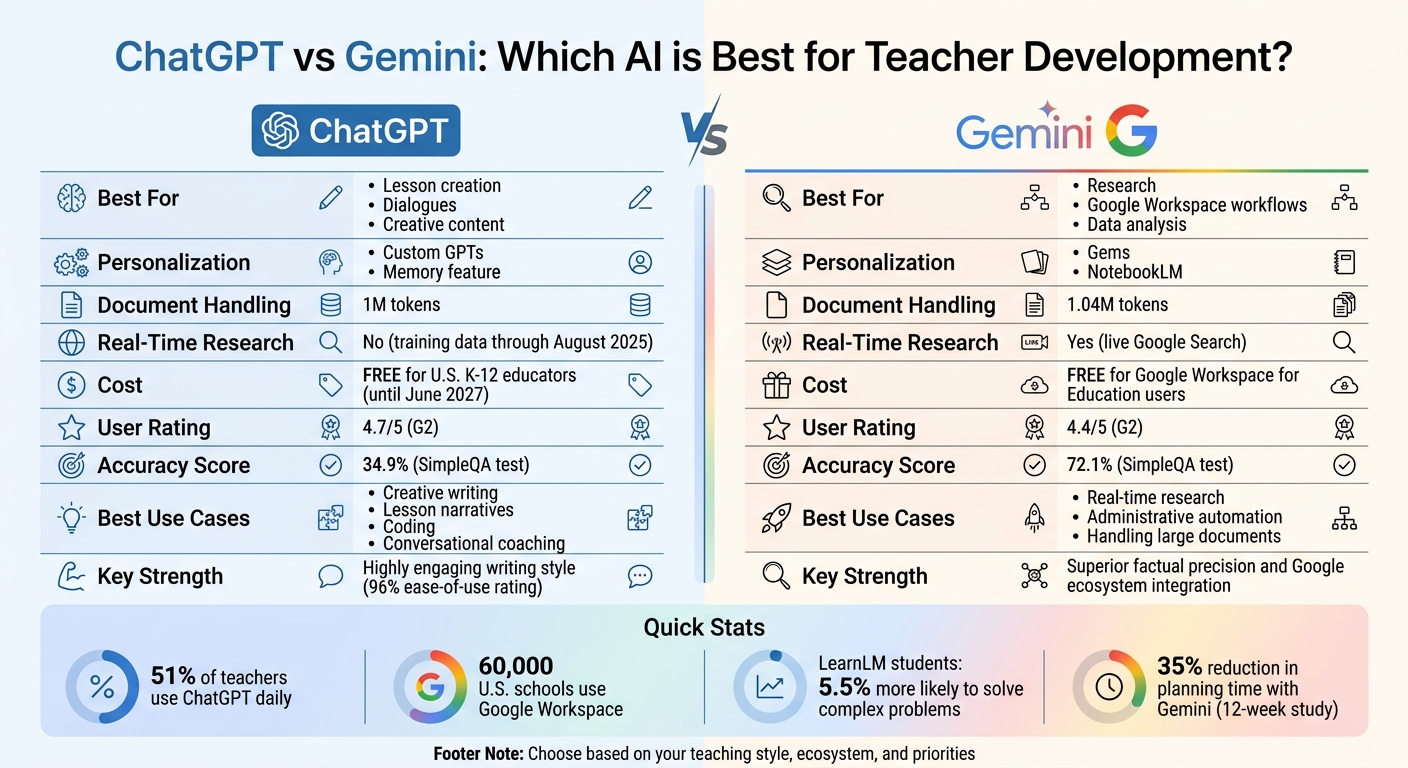
ChatGPT vs Gemini for Teachers: Feature Comparison Chart
ChatGPT: Features, Strengths, and Use Cases
Key Features of ChatGPT
ChatGPT offers tools designed to simplify teacher workflows and enhance productivity. For instance, educators can create custom GPTs tailored to specific needs, such as a "Lesson Planner" or "Rubric Generator", pre-loaded with state standards or textbook chapters. The Canvas feature allows teachers to draft lesson plans with inline suggestions and export them as PDF or Word documents.
The Deep Research tool compiles information from hundreds of sources into cited reports, making unit planning more efficient. Meanwhile, Advanced Data Analysis transforms performance data into charts and statistics - no coding required. Additionally, the Memory and Projects feature retains key details like grade levels, curriculum standards, and teaching preferences across sessions, ensuring a personalized experience.
These tools form the backbone of ChatGPT's ability to support educators in practical and meaningful ways.
ChatGPT's Strengths for Educators
ChatGPT stands out for its ability to generate content quickly and adapt to various tasks. Its Voice Mode enables real-time spoken conversations, which can be invaluable for language practice or hands-free lesson planning. Another standout feature is Study Mode, which uses Socratic questioning to guide learners with hints rather than providing direct answers.
Research backs up its effectiveness: a meta-analysis of 37 studies found that ChatGPT moderately enhances learning outcomes (g = 0.577). Additionally, 70.2% of students reported saving time by using ChatGPT. However, it's worth noting that GPT-4 has a 28.6% error rate, highlighting the need for careful oversight.
According to Med Kharbach, PhD, Founder of Educators Technology, "ChatGPT serves best as a starting point for professional judgment".
These strengths highlight its potential to support teachers in various professional development scenarios.
Teacher Development Use Cases
ChatGPT's features and strengths translate directly into practical applications for teacher development. For example, 51% of teachers report using ChatGPT daily. In November 2025, OpenAI launched "ChatGPT for Teachers", offering free premium access to verified U.S. K–12 educators through June 2027. Early adopters included major school districts like Dallas ISD, Fairfax County Public Schools, Houston ISD, Fulton County Schools, and the Delaware Department of Education.
In early 2026, a $23 million partnership funded AI training for over 400,000 K–12 educators through the National Academy for AI Instruction. Teachers have used ChatGPT to create tiered prompts tailored to struggling, grade-level, and advanced learners, as well as to develop course-specific GPTs by uploading syllabi and preferred resources. These use cases demonstrate how ChatGPT can be a valuable tool for improving teaching strategies and outcomes.
sbb-itb-903b5f2
Gemini: Features, Strengths, and Use Cases
Key Features of Gemini
Gemini takes a fresh approach to teacher development with its seamless integration into Google Workspace. This setup allows educators to access Gemini directly within Google Workspace, eliminating the hassle of switching between apps. The side panel feature makes it easy for teachers to refer to existing Drive files while crafting new lesson plans, ensuring alignment with prior materials.
One of Gemini's standout tools is NotebookLM, a research assistant tailored to work exclusively with teacher-supplied resources like textbooks and curriculum guides. It can generate summaries, study guides, and even podcast-style "Audio Overviews". Another unique feature is the ability to create customizable "Gems" - AI assistants fine-tuned with specific instructions, district standards, or teaching methods. For example, educator Eric Curts launched the EduGems community site, which now offers around 200 teacher-designed Gems for sharing across schools.
Gemini also boasts multimodal capabilities, enabling it to process text, images, audio, and video seamlessly. Teachers can analyze handwritten student notes or create audio lessons to cater to diverse learning preferences. With a context window of up to 1.04 million tokens, the platform can process entire textbooks in a single session. On the privacy front, Gemini ensures compliance with FERPA and COPPA by employing enterprise-grade protections that prevent student data from being used in model training.
These features make Gemini a powerful tool for supporting educators in practical, classroom-focused ways.
Gemini's Strengths for Educators
Gemini's integration with Google Workspace - already utilized by roughly 60,000 U.S. schools - positions it as a natural fit for districts that rely on Google's ecosystem. What sets Gemini apart from general-purpose AI platforms is its LearnLM model, which is specifically fine-tuned for educational psychology. Research shows that students working with LearnLM were 5.5 percentage points more likely to solve complex problems compared to those guided solely by human tutors.
The platform's Guided Learning Mode uses Socratic questioning to encourage educators to think critically rather than simply providing answers. Additionally, Gemini shines in administrative automation through its Workspace Studio, where teachers can design no-code AI tools to handle tasks like managing emails, organizing permission slips, and keeping track of attendance.
Teacher Development Use Cases
Gemini's robust features translate into real-world benefits for teacher development. In late 2025, a suburban school district ran a 12-week blended professional development program focused on math formative assessment. The program combined an AI tutor with weekly lesson studies led by district coaches. The results? A 35% reduction in planning time, a 20% improvement in observation scores, and a 9% increase in student assessment performance. These outcomes highlight the effectiveness of Gemini's Guided Learning Mode and Workspace Studio.
"Product manager Vivek Chachcha reported that teachers used Gemini to customize math assignments by centering them on Taylor Swift's Eras Tour - calculating ticket sales and attendance - which resulted in measurable increases in student engagement".
Additionally, Gemini's "re-level" feature allows teachers to adjust reading materials or assignments to match different reading levels, making it a valuable tool for differentiated instruction.
ChatGPT vs Gemini: Direct Comparison for Teacher Development
Feature Comparison
Both ChatGPT and Gemini bring distinct strengths to teacher professional development, each excelling in specific areas. ChatGPT stands out in creative writing and conversational coaching, making it a great tool for brainstorming lesson plans or exploring teaching scenarios. It also offers features like continuity in teaching preferences and specialized tools for tasks like creating rubrics or tutoring vocabulary .
Gemini takes a more research-focused approach, using real-time Google Search integration to provide updates on current educational trends. It also integrates seamlessly with Google Workspace, allowing users to upload resources like district standards or curriculum guides. When it comes to handling large documents, Gemini's 1.04 million token context window slightly surpasses ChatGPT's 1 million tokens.
| Feature | ChatGPT | Gemini |
|---|---|---|
| Best Professional Development Use | Idea generation, dialogue support, structured content creation | Real-time research, data analysis, Google Workspace workflows |
| Personalization Tool | "Memory" for long-term context + "Custom GPTs" | "Gems" for custom tutors + "NotebookLM" for source-specific analysis |
| Document Handling | Strong at pattern recognition across essays | Superior for handling extremely long documents |
| Information Freshness | Training data through August 2025 | Live Google Search for current educational research |
| Context Window | 1 million tokens | 1.04 million tokens |
In terms of accuracy, Gemini 3 Pro scored 72.1% on the SimpleQA Verified test, outperforming ChatGPT's 34.9%, showing stronger factual precision. However, ChatGPT boasts a higher user satisfaction rating of 4.7/5 on G2 compared to Gemini's 4.4/5.
These differences highlight the unique advantages and limitations of each platform.
Pros and Cons
The following table breaks down the practical benefits and challenges of each tool for educators.
| AI Tool | Pros | Cons |
|---|---|---|
| ChatGPT | - Highly engaging writing style (96% ease-of-use rating) - Free for verified U.S. K–12 educators through June 2027 - Excellent for coding and technical problem-solving |
- Limited real-time research capabilities - Relies on training data cutoff - Less integrated with productivity suites |
| Gemini | - Seamless Google Workspace integration - Higher content accuracy scores (8.5/10 vs. 8.0/10) - Superior at citing sources from web research |
- Steeper learning curve for non–Google users - More expensive for individual use ($19.99/month) |
"ChatGPT consistently performs better for creative writing, coding, and conversational tasks, while Gemini excels in real-time research, multimodal processing, and Google ecosystem workflows." – G2
Which Tool Fits Different Educator Needs
For educators navigating modern professional development, both ChatGPT and Gemini cater to specific needs, making the choice largely dependent on individual workflows and priorities.
Choose ChatGPT for creating lesson narratives, crafting personalized instruction materials, or developing dynamic teaching dialogues. It’s especially useful for educators working across multiple platforms (like Microsoft and Google) who value a tool that delivers high-quality creative outputs without complicating workflows. The free access for verified U.S. K–12 educators also makes it a budget-friendly option.
Opt for Gemini if your school operates within the Google Workspace ecosystem and you value real-time, research-backed insights. Teachers who need tools for data analysis, research citation, or in-app support within Docs and Sheets will find Gemini highly effective. Its ability to manage lengthy documents is especially helpful for tasks like curriculum design or analyzing extensive student portfolios.
"The difference between AI that works and AI that wastes your time often comes down to details that generic reviews never mention." – Fely Garcia Lopez, SchoolAI
For those seeking deeper, research-oriented professional growth, Gemini's higher performance on PhD-level reasoning benchmarks (91.9% vs. ChatGPT's 88.1%) suggests it’s better suited for tackling complex educational questions. On the other hand, if you’re looking for a user-friendly tool that adapts to your teaching style and excels in conversational tasks, ChatGPT's ease-of-use and engaging writing capabilities make it a strong contender.
Ultimately, the best choice depends on your specific needs and the ecosystem you rely on.
NanoGPT: Access to ChatGPT, Gemini, and More
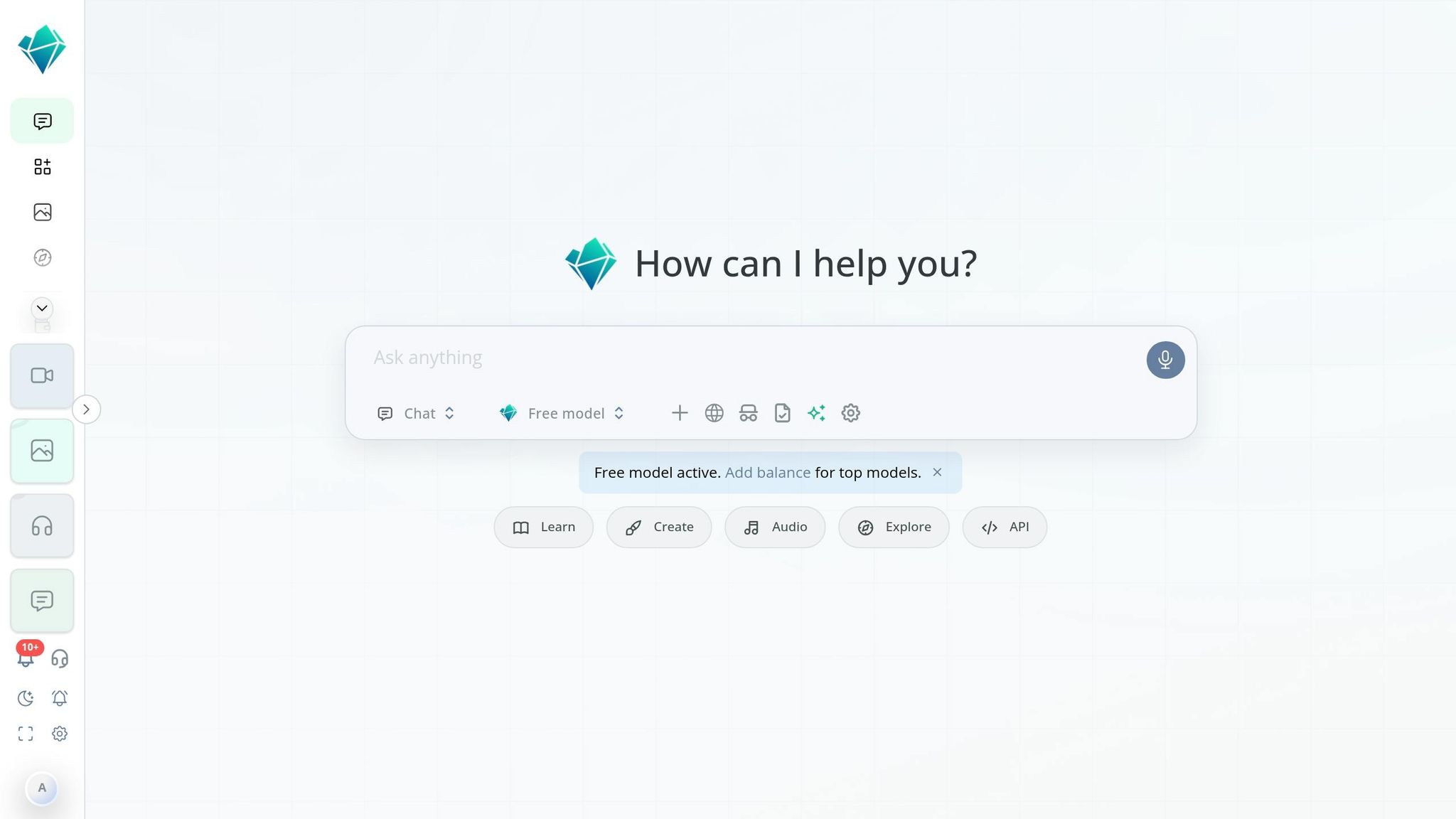
What is NanoGPT?
NanoGPT is a platform designed to simplify access to AI tools like ChatGPT, Gemini, and over 200 other models. Instead of juggling multiple accounts and subscriptions, educators can use this pay-as-you-go service to access everything in one place. Pricing is straightforward - around $0.10 for minimal usage - and there are no monthly fees.
One standout feature is its focus on privacy. NanoGPT stores data locally on your device, which is a huge plus for teachers dealing with sensitive classroom or student information. While you can use the platform without creating an account, signing up ensures your balance is saved even if you clear your browser cookies.
Benefits for Teachers
NanoGPT offers a practical alternative to the costly subscriptions of individual AI services. For example, ChatGPT Plus and Gemini Advanced each cost about $20 per month. If you need both, that's $40 monthly - even during times when your AI usage is low, like summer breaks or holidays.
"If your AI usage dips, it can feel like you're paying for an all-you-can-eat buffet even when you're on a diet." - lairdutemps, Writer
With NanoGPT's usage-based pricing, teachers only pay for what they use. This flexibility is ideal for educators whose workloads fluctuate, with higher demand during grading periods or lesson planning and a drop-off during breaks. Plus, there are no registration fees or hidden costs, making it a hassle-free choice.
The platform also streamlines workflows by allowing instant switching between models. For example, you can use ChatGPT for crafting creative exercises and then switch to Gemini for real-time research - no need to manage multiple logins or tabs. This seamless integration saves time and supports a variety of teaching tasks efficiently.
How Teachers Can Use NanoGPT
NanoGPT enables educators to adapt AI tools to specific classroom needs. You can pair each task with the AI model best suited for it. For example:
- Use ChatGPT for creating writing prompts or drafting social media posts for your class.
- Switch to Gemini for up-to-date information, like researching new educational standards or recent scientific developments.
The platform even allows side-by-side testing of outputs from different models. Running a prompt through both ChatGPT and Gemini helps you compare results and choose the most effective one. This flexibility makes NanoGPT especially valuable for teachers experimenting with AI to enhance their teaching methods without committing to costly subscriptions.
Conclusion: Choosing the Right AI for Teacher Development
What Educators Should Consider
If your school operates heavily within the Google Workspace ecosystem - relying on tools like Gmail, Docs, Drive, and Classroom - Gemini is a natural fit due to its seamless integration. On the other hand, if you’re tackling creative projects, complex coding, or need a standalone AI solution, ChatGPT is the better choice.
Budget is another critical factor. Verified U.S. K–12 teachers can use ChatGPT for Teachers at no cost until June 2027. This includes advanced features like GPT-5.1 Auto and Deep Research. Meanwhile, Gemini for Education remains free for anyone with a Google Workspace for Education account. Be sure to confirm your eligibility for these free programs to maximize your resources.
When it comes to teaching styles, Gemini employs Socratic questioning, encouraging deeper understanding, while ChatGPT focuses on delivering quick, straightforward answers. Interestingly, research suggests that guided questioning helps learners retain information three to four times longer compared to passive learning methods. These differences can help you decide which tool aligns best with your teaching approach.
Final Thoughts on ChatGPT, Gemini, and NanoGPT
Ultimately, your choice of AI tool should align with your workflow, budget, and teaching style. Both ChatGPT and Gemini have grown from simple tools into reliable teaching aids. ChatGPT shines in creative problem-solving and complex reasoning, while Gemini’s extended token window is perfect for real-time research and managing large documents. Together, they highlight how AI is reshaping teacher development.
For those who prefer flexibility, NanoGPT offers a pay-as-you-go model with a $0.10 minimum, making it ideal for low-usage periods. It also prioritizes local data storage, ensuring sensitive classroom information stays private. This makes NanoGPT a smart option for educators who value both affordability and data security.
ChatGPT vs GOOGLE GEMINI: Which is BETTER for TEACHERS?
FAQs
How can I verify eligibility for the free teacher plans?
To see if you're eligible for free teacher plans, start by checking whether your institution has an agreement in place with the platform. Additionally, some platforms offer dedicated programs specifically for educators. Many AI providers rolled out education-focused initiatives and free access for teachers during 2025 and early 2026.
What’s the safest way to use AI with student data?
The best way to handle AI with student data is by selecting tools that prioritize privacy and security. Take Gemini, for instance - it provides a secure platform with built-in features to protect student information and maintain data privacy. Make sure any AI tool you use meets established data protection standards to keep sensitive information safe.
How do I decide which tasks to do in ChatGPT vs Gemini?
When deciding between ChatGPT and Gemini, consider what you need most. ChatGPT is perfect for tackling a variety of tasks, such as writing, coding, lesson planning, creating assessments, or providing detailed feedback. It shines when generating well-rounded content and thorough explanations.
On the other hand, Gemini is ideal if you're heavily invested in Google Workspace tools like Gmail, Docs, or Drive. It offers smooth collaboration, brainstorming capabilities, and secure, productivity-oriented support, making it a strong choice for those who rely on Google's ecosystem.
Ultimately, the decision comes down to whether you value flexibility or a closer connection to Google services.